
MISTPLAY: Play to Earn Money
MISTPLAYEntertainment
4.4178.12K Reviews
- Version
- 6.42.1
- Installs
- 50.00M
- Age Rating
- Teen
Screenshots
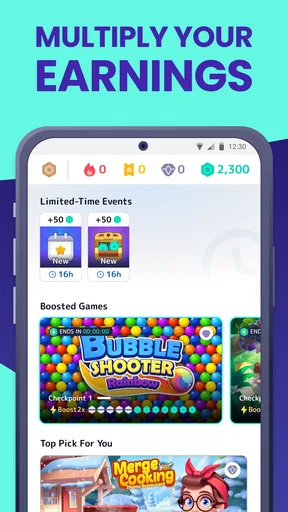
Our Review of MISTPLAY: Play to Earn Money
 Analysis by Appyee
I approached MISTPLAY as a way to turn spare gaming time into something useful, rather than as a replacement for a normal rewards program. Developed by MISTPLAY, this free entertainment app connects game discovery with rewards that can be redeemed in the app. That basic idea is appealing, but the quality of the experience depends heavily on how patiently you choose games, how consistently your phone stays connected, and how realistic your expectations are about earning.
The app has clearly reached a large audience: it has a 4.4 average from around one million ratings and more than 50 million installs. Those figures make it easier to see why people are curious, but they do not automatically mean it will suit every player. I found its strongest use case to be casual gaming during small gaps in the day. If you already enjoy trying mobile games, the reward layer can make that exploration feel more worthwhile. If you dislike promotional discovery or want predictable income, the appeal is much weaker.
How the reward-and-game-discovery model feels in everyday use
The central experience is simple to understand. You enter a catalog of games, choose something that interests you, play it, and work toward rewards that can eventually be cashed out in the app. I like that this gives casual players a reason to sample games they might otherwise ignore. Instead of downloading a title only to delete it after a few minutes, I am more likely to give it a fair trial when progress has a reward attached.
That does not make every game equally enjoyable. The catalog is the real center of the experience, and personal taste matters more here than in a conventional entertainment app. Someone who likes experimenting with different mobile genres may find plenty to do. Someone who already has a small group of favorite games may feel that the reward system is asking them to spend time on titles they would not have selected independently.
I also think it is important to separate playing for rewards from earning a dependable amount of money. The app is better understood as a bonus system for leisure time. A short session may feel satisfying because it combines entertainment with progress, but that is different from having a reliable side income. Keeping that distinction in mind prevents the experience from becoming frustrating.
The developer identifies the app as MISTPLAY, and the current version is 6.29.1. It supports devices running Android 7.0 or later, which makes it accessible to people using older compatible phones as well as newer models. Its Teen content rating is another reason parents and younger users should treat the app as an entertainment platform to review together rather than assuming every listed game will suit every household.
Why a stable connection matters more than it first appears
Connectivity shapes almost every important moment. The app needs to present available games, register activity, and keep the reward journey aligned with what you are doing. When the connection is steady, the process feels reasonably direct: browse, select, play, and check your progress. When the network is weak, the uncertainty becomes more noticeable because you may not immediately know whether an action has been recognized.
I would avoid beginning a new session in a place where the signal is constantly dropping. A game may still open, but the surrounding reward experience can feel less dependable when the app cannot communicate normally. This is especially relevant on public transport, in large buildings, or in rooms where Wi-Fi changes between access points. The practical lesson is simple: start the session while connected well, and give the app time to reflect progress before closing it.
A realistic example is a lunch break. If I have a reliable connection, I can browse the available choices, select a game, and play for a while without treating every pause as a technical problem. If the same break takes place in a patchy-signal area, I would rather play something I already know I enjoy than use that limited time testing whether progress has synchronized. Connectivity is part of the workflow, not just a background convenience.
This is also where the app differs from an ordinary mobile game. With a conventional game, a temporary network problem may affect only features such as leaderboards or account services. Here, the connection is tied more closely to the reason for using the app in the first place. That makes network interruptions feel more consequential, even when the game itself seems playable.
Using it on short breaks, commutes, and at home
The best mobile context for MISTPLAY is a predictable block of free time. I found the idea most convincing when I could choose a game without rushing, play long enough to decide whether it suited me, and then return later with a clear sense of what I wanted to continue. Short sessions can work, but constantly switching between games may make the experience feel like browsing rather than playing.
At home, a stable Wi-Fi connection makes the app easier to live with. I can explore the catalog without worrying that a brief mobile signal change will interrupt the process. At the same time, using it at home can expose a different weakness: the reward may not be enough to compete with the games, streaming services, or hobbies I already prefer. The app works best when it adds value to gaming time I was going to spend anyway.
On a commute, I would be more selective. A journey with dependable connectivity can be a good chance to try a new title, but a trip through areas with frequent dead spots is less suitable for reward-focused play. I would also avoid treating every spare minute as an obligation to open the app. The experience loses its charm if the reward goal makes leisure feel like a task.
For people with limited mobile data, the sensible approach is to prepare around a trusted Wi-Fi connection whenever possible. Game downloads and updates can consume more data than a quick rewards check, so I would not start downloading unfamiliar titles casually while using a restricted mobile plan. MISTPLAY can fit a data-conscious routine, but only if the user controls when discovery and downloads happen.
What happens when progress feels delayed or interrupted
The most important habit I would recommend is giving the app a moment to catch up before ending a session. If I finish playing and immediately force-close everything while the connection is unstable, I create unnecessary doubt about whether the latest activity has been recorded. Waiting briefly on a good connection is a small step, but it makes the overall experience easier to trust.
If something appears not to update, I would first check the obvious causes: connection quality, whether the app is current, and whether the phone has enough available resources to keep both the game and the rewards app behaving normally. I would then reopen the app calmly rather than repeatedly tapping through screens. Repeated attempts during a weak connection can make it harder to tell whether the problem is temporary or whether the session genuinely needs attention.
This is one of the trade-offs that does not appear in a short store description. The reward model adds a layer of record-keeping to ordinary play. A normal game session can end whenever I want; a reward-oriented session makes me more aware of transitions, synchronization, and whether the app has recognized what happened. That extra awareness is manageable, but it is part of the cost of using this format.
I would also keep expectations measured after reinstalling, changing devices, or moving between networks. Account-based experiences are generally more comfortable when the user keeps access details organized and avoids treating the app as disposable. I am not suggesting a guaranteed recovery process for every situation; I am saying that careful session habits reduce avoidable confusion.
How to protect a limited data plan and your attention
My preferred routine is to browse and install games on Wi-Fi, then use mobile data only when I know the connection is stable and the session is worth starting. I would also avoid opening the catalog repeatedly just to see what has changed. That habit uses attention as well as data, and it can turn a casual rewards app into a constant source of small interruptions.
Another useful tactic is to choose one game at a time instead of spreading attention across every option that looks promising. This makes it easier to judge whether I genuinely enjoy the title and whether the time spent feels worthwhile. It also reduces the number of downloads and context switches. The app encourages discovery, but disciplined discovery is more satisfying than collecting games I never intend to play.
I would keep notifications and phone settings in mind, too, without allowing the app to dictate my day. A rewards system can tempt users to chase every available opportunity, even when the value is too small to justify the interruption. For me, the right boundary is to open it when I already want to play, not because I feel pressured to maintain constant activity.
There is also a privacy-minded practical point: review what the app and each selected game ask you to do before committing time. Different games can create different expectations around accounts, downloads, and network use. I would not assume that choosing a game inside MISTPLAY makes every surrounding requirement identical. Reading the relevant prompts and keeping control over downloads is a better approach than accepting everything automatically.
Who will enjoy it, and who should choose something else?
MISTPLAY is a good fit for a person who already plays mobile games casually and enjoys variety. It is especially suitable for someone who sees gift cards or other in-app prizes as a pleasant extra rather than a guaranteed payoff. The free price removes the need to make an upfront purchase, so experimenting feels relatively low-risk from a cost perspective.
It may also suit parents or families who want to understand what a teenager is playing, provided the Teen rating and the individual games are considered carefully. The rating does not turn the entire catalog into a single uniform experience. I would still look at the specific title and decide whether it fits the player and the household.
I would skip it if my main goal were a fixed return for a fixed amount of time. I would also be cautious if I had very limited storage, a highly restricted data plan, or unreliable connectivity. In those situations, a normal game selected directly from the usual app store may be less complicated. It will not provide the same reward path, but it can offer a cleaner and more predictable play session.
Compared with ordinary entertainment apps, MISTPLAY has a clear advantage: it gives mobile gaming a tangible incentive beyond the game itself. Compared with direct game downloads, it adds discovery and reward tracking but also adds dependence on the surrounding platform. Compared with survey or cashback services, it is more enjoyable for people who genuinely like playing, but less appropriate for someone who wants the fastest possible route to a small reward.
My practical verdict after weighing the trade-offs
The app’s biggest strength is that it makes trying mobile games feel more purposeful without charging an entry price. Its biggest weakness is that the reward layer can make connectivity, session timing, and progress tracking more important than they would be in a regular game. I enjoyed the concept most when I treated it as a curated way to find something fun, not as a job.
The scale of its audience suggests that the model has broad appeal, and the 4.4 average supports the impression that many users find value in it. Still, popularity should not replace a personal test. The right question is not whether the app can reward anyone in the abstract, but whether the games available match your interests and whether your connection and data habits make the process comfortable.
My recommendation is to begin with a stable Wi-Fi connection, choose a game you would plausibly enjoy without the reward, and play for long enough to judge the complete routine rather than only the first few minutes. Check that progress appears to update before leaving, avoid unnecessary downloads on mobile data, and do not confuse occasional prizes with dependable earnings. Those habits make the experience calmer and more honest.
Overall, I see MISTPLAY as a worthwhile free entertainment app for patient casual players who want rewards attached to game discovery. It is not the best choice for people seeking guaranteed income, instant results, or an experience that remains unaffected by poor connectivity. For the right user, though, it turns otherwise idle gaming time into a small opportunity to work toward in-app prizes—and that is a useful idea when approached with realistic expectations.
Privacy and Permissions
See what permissions an app requests and how it handles your data.
- Location
- approximate location (network-based), precise location (GPS and network-based)
- Wi-Fi connection information
- view Wi-Fi connections
- Other
- view network connections, pair with Bluetooth devices, access Bluetooth settings, change network connectivity, connect and disconnect from Wi-Fi, full network access, run at startup, draw over other apps, control vibration, prevent device from sleeping, set an alarm, Google Play license check, read Google service configuration
Verdict
Strengths of MISTPLAY: Play to Earn Money
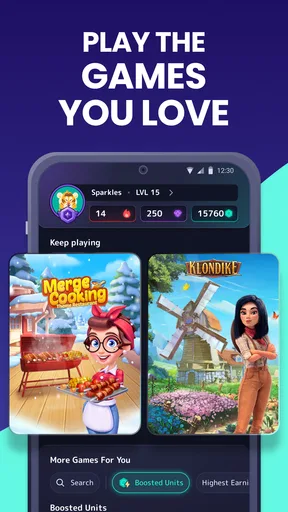
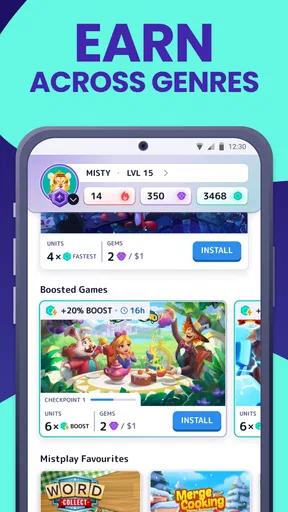
- Large selection of mobile games across several genres.
- Simple reward system that is easy for beginners to understand.
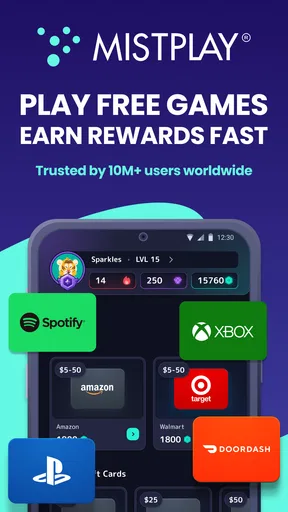
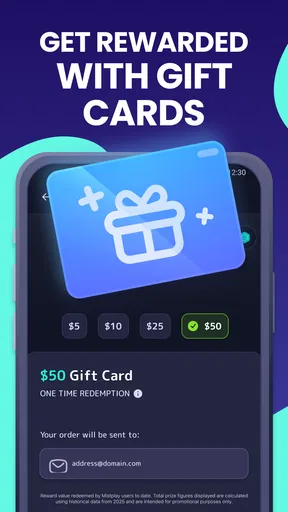
- Offers gift cards from popular retailers and services.
- Tracks points and milestones directly inside the app.
- New game recommendations can help users discover hidden gems.
Limitations of MISTPLAY: Play to Earn Money
- Rewards and available games may vary depending on your country.
- Some offers require reaching high levels before points are credited.
- Earnings are modest and should not be treated as regular income.
- The app may request extensive usage and advertising permissions.
- Points can occasionally be delayed or require manual support review.
Similar Picks in This Category
View All
Google Play Games
Google LLC3.9

Netflix
Netflix, Inc.4.8

YouTube Kids
Google LLC4.2

Disney+
Disney4.4

Prime Video
Amazon Mobile LLC4.7

Steam
Valve Corporation3.2
Frequently Asked Questions
What is Mistplay: Play to Earn Money, and how does it work?
Mistplay is a rewards app for Android that lets you discover and play selected mobile games while earning units. Your progress, playtime, and available promotions determine how many units you receive. These units can usually be exchanged for gift cards or other rewards, depending on your location. It is best viewed as a loyalty program for gaming rather than a reliable income source.
Can I really make money with Mistplay?
Mistplay can provide gift cards and similar rewards, but the earnings are generally modest and require consistent activity. The amount you earn depends on the games offered, your engagement, promotional bonuses, and regional availability. Reaching a worthwhile redemption balance may take time, so users should not expect the app to replace a job or generate guaranteed cash quickly.
Is Mistplay free to download and use?
Yes, Mistplay is generally free to download and use. You do not normally need to pay an upfront subscription to access its game-reward system. However, the app may include advertising, sponsored offers, tracking permissions, and in-app promotions. Before installing games through Mistplay, review the requested permissions and remember that mobile data usage may apply when downloading or playing.
What rewards can I redeem in Mistplay?
Available rewards vary by country, account status, and current catalog. Mistplay commonly offers digital gift cards from popular retailers, although the exact brands, denominations, and redemption methods can change. Some rewards may become temporarily unavailable or require a minimum number of units. Check the in-app rewards section before spending time on a specific offer, because availability is not identical for every user.
Is Mistplay safe, and what should I know about privacy?
Mistplay is a legitimate rewards platform, but using it means sharing certain information related to your device, gameplay, and app activity. This data helps the service measure engagement and credit rewards. Download the app from an official store, avoid unofficial modified versions, and read its privacy policy and permission requests. Also verify the minimum age, eligibility rules, and account requirements in your region before signing up.
